
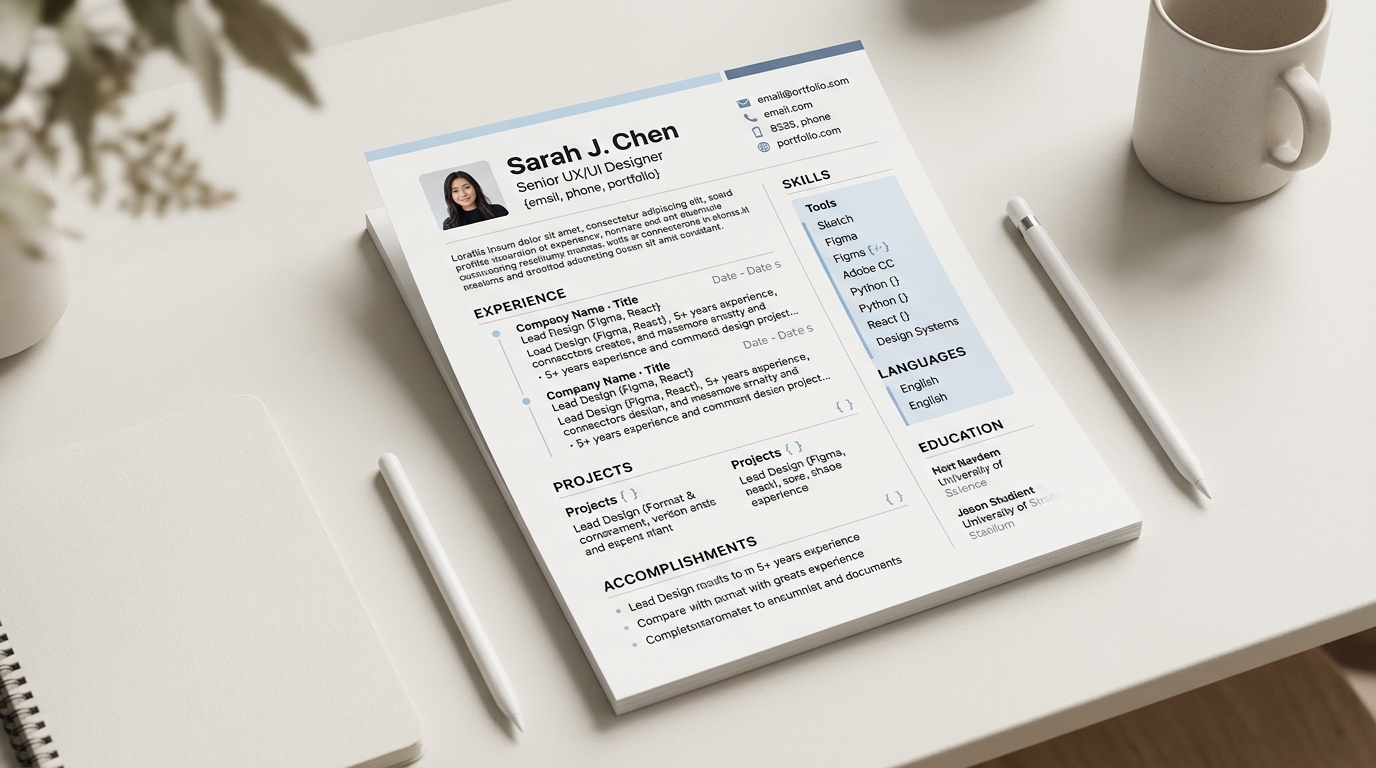
Start from the job, not the template
Before you open an editor, read the job posting closely and note what it actually asks for: the title, the core responsibilities, the tools it names. Then gather your own material - past roles, dates, and the specific things you did in each - before you think about formatting at all.
If you are not sure which layout to pick, start with a single-column one; it is the safest default for both a human skim and an applicant tracking system, and you can always try a two-column layout once the content itself is solid. Decide the file format too: PDF is the right default unless a posting explicitly asks for something else.
Header: name, one contact line, done
Your name should be the most prominent line on the page. A one-line headline under it - your current or target role - is optional but useful when your job title alone does not make your field obvious. Below that, one compact line of contact details: phone, a professional email address, your city or region, and a portfolio or LinkedIn link if it is relevant to the role.
Skip the full mailing address; city and region is enough for almost every application today and keeps the header short. Whether to include a photo depends heavily on where you are applying - see the FAQ below, since the norm is genuinely different by country.
Summary: two or three sentences that orient the reader
A resume summary sits directly under the header: two to three sentences stating your role, your years of relevant experience, and one or two concrete strengths. It replaces the older objective statement for most applications, because it tells the reader what you offer instead of what you want.
Write it last, after the rest of the page is drafted - it should compress what is already true below it, not introduce new claims. The resume-summary-examples guide covers this section in depth, with a full worked example.
Experience: reverse-chronological, results over duties
List roles most recent first: title, company, dates, and location, followed by three to six bullet points for your most recent or most relevant roles, tapering to one or two for older ones. Use bullet points, not paragraphs - a reader skims a resume, they do not read it top to bottom like an essay.
Favor a result over a duty wherever the two differ. For example, swap a line like
“Responsible for managing the support queue”
for something like "Cleared a 200-ticket backlog and cut average response time from two days to four hours." The second version is a made-up illustration of the pattern, not a claim about typical results - the point is the shape: what changed, not just what you were assigned to do.
Education and skills: specific, not decorative
An education entry needs the degree, the institution, and the dates - that is usually all it needs, unless the role is early-career enough that coursework or a relevant project belongs there too. If you have limited work experience, put education above experience; once you have a real work history, move it below.
List skills as specific tools, technologies or methods rather than vague traits. "Hardworking" and "team player" describe almost any candidate and give a reader nothing to act on; naming the actual language, platform or process you used does.
Final polish: the pass most people skip
Before you send it, do one pass purely for consistency: past tense for past roles, present tense for your current one, one date format used throughout, and the same punctuation style on every bullet. These are small details, but a reader notices when they are inconsistent even if they cannot say exactly why the page felt sloppy.
Save the final file as a PDF - it keeps your layout intact across whatever device or software opens it - and name the file something a recruiter can find later in their downloads folder, like "YourName-Resume.pdf" rather than "resume-final-v3.pdf".
Frequently asked questions
- Should I include a photo on my resume?
- It depends on where you are applying. US and UK employers generally expect no photo and some even discourage one. Many other markets, including Vietnam, commonly expect a professional photo as standard. Check the norm for the country and employer you are applying to rather than defaulting to one convention everywhere.
- Do I still need an objective statement?
- For most applications, a summary that states what you offer works better than an objective statement about what you want - the posting already tells the reader what role you are applying for. The one case an objective-style line still earns its place is a genuine career change, where the top of the page needs to explicitly name the target role, since your work history alone will not make that obvious.
- How many bullet points should each job have?
- Three to six for your most recent or most relevant roles, tapering to one or two for older or less relevant ones. Consider cutting roles beyond roughly ten to fifteen years back entirely, unless they are directly relevant to this specific application.
- What file format should I submit?
- PDF, unless the job posting or application portal explicitly asks for something else, like a Word document. A PDF keeps your formatting intact wherever it is opened, and most modern systems - including applicant tracking systems - read PDFs without issue. See the ATS-friendly resume guide for what actually affects parsing.