
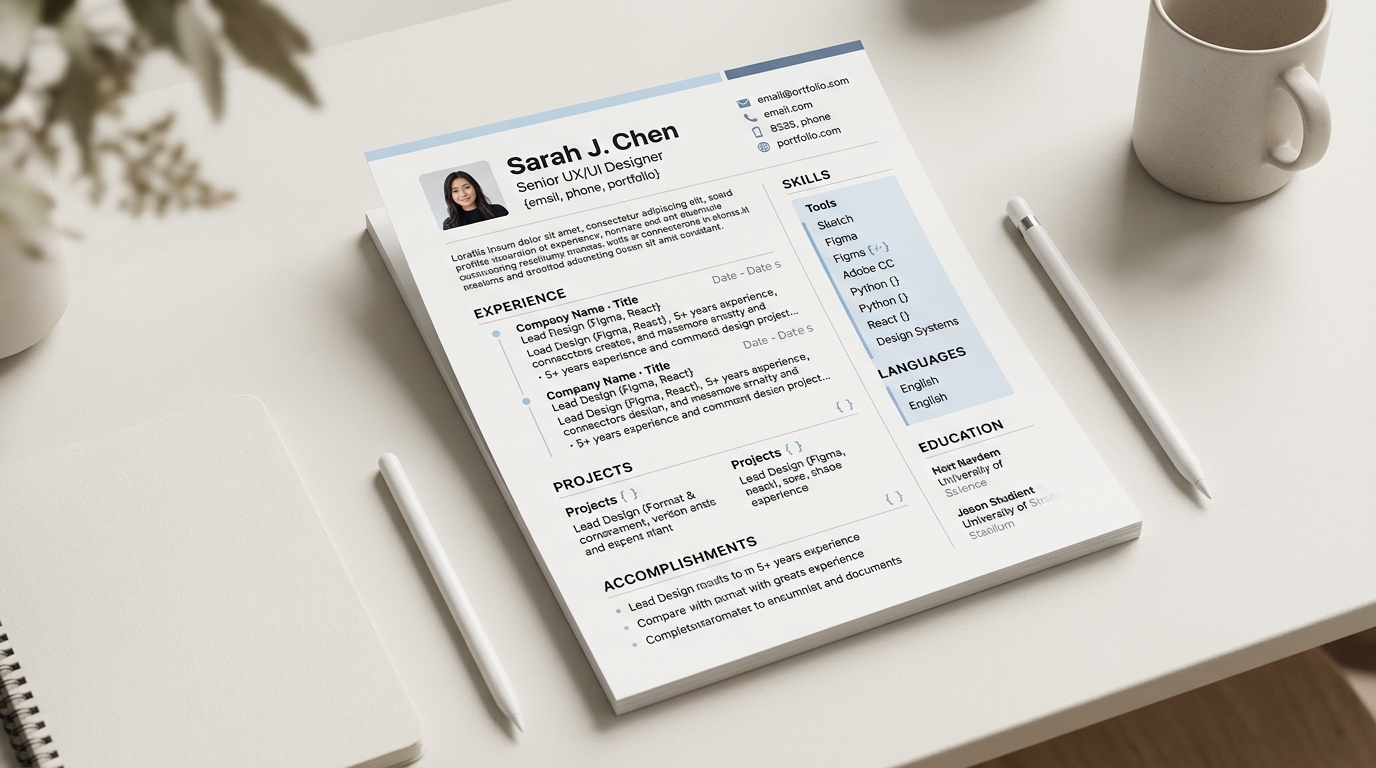
Why the summary carries so much weight
Sitting directly under the header, the summary is the first prose a reader hits, on a page that is often skimmed in a matter of seconds. It either earns a slower read from there or it does not. Its job is to orient a reader who does not yet know your title, seniority or domain, in the fewest possible words.
It is not a cover letter in miniature and not a short biography. It should state facts - role, years, focus area - rather than opinions about yourself. Words like "hardworking" or "passionate" read as filler precisely because they are unverifiable and appear on nearly every resume.
Summary versus objective
An objective statement says what you want:
“Seeking a position in software engineering where I can grow my skills.”
That made sense decades ago, when a paper application could land anywhere. Today the posting already tells the reader what role you are applying for, so an objective spends the top of the page restating information they already have.
A summary says what you offer instead, and leads with evidence rather than intent. The one case where an objective-style line still earns its place is a genuine career change, where the top of the page needs to explicitly name the target role and the transferable strength behind it, because the work history below will not make that connection obvious on its own.
How to actually write one
Three parts: your role plus years or domain, one or two concrete strengths named as a skill or a scope rather than a trait, and - only if it is genuinely true - one measurable anchor from the work itself, such as a team size or a system's scale. Leave that last part out entirely rather than inventing a number to fill it.
Write the summary last, after the experience section is drafted. It should compress what is already true on the page below it - writing it first, before that material exists, is usually what produces vague filler in the first place.
A worked example
A weak summary:
“Hardworking professional with strong communication skills seeking to leverage my experience in a dynamic environment.”
Every phrase in that sentence could describe almost any candidate for almost any role - it gives a reader nothing they can act on or verify.
A stronger rewrite, for a fictional candidate:
“Backend engineer with six years building payment infrastructure in Node.js and Postgres, most recently leading the migration of a monolith service into three independently deployable APIs.”
It names the domain, the stack, and a seniority signal - leading a migration - all facts a reader can verify against the experience section right below it.
Professional summary examples by level
An entry-level example:
“Computer science graduate whose capstone project cut a mock API's response time by 40% through caching, now seeking a first full-time engineering role.”
It works because it names a concrete project and a real result, not just a degree. A mid-level example: "Marketing coordinator with four years running paid social campaigns, most recently cutting cost-per-lead by a third on a $200k annual budget." It names a role, a tenure, and one checkable number.
A senior example should show scope, not just tenure:
“Engineering manager leading a team of nine across two time zones, responsible for a platform serving 2 million requests a day.”
Team size and system scale signal what kind of decisions this person makes. At every level, name the level explicitly - graduate, coordinator, manager - so the reader is not left guessing.
A summary when you are applying to several kinds of job
The common mistake is one vague summary meant to cover every role, which ends up saying nothing specific enough to help any of them. The fix is to find the thread the jobs share - a skill, a domain, a way of working - and lead with that. Someone applying to both operations and customer-success roles might write:
“Operations professional with three years managing vendor relationships and resolving escalations, comfortable running a process from the back office or the front line.”
Adapting it per application takes under five minutes: swap the job-title phrase and the one proof point that best matches the posting, and leave the rest as written. The rule that does not bend is honesty - never claim a job title you have not actually held, even when the target role uses different words for work you have done.
Skills summary: when a list beats a paragraph
A skills summary trades the usual paragraph for three to six grouped skills, each backed by one line of proof, replacing or sitting under the prose summary. It suits technical roles, trades, and career changers, where a reader is scanning for capabilities rather than a story. A grouped example:
“Data: SQL, dbt, Looker - built the reporting layer a 40-person sales team checks daily.”
Leave out soft-skill adjectives like "team player" - they carry no proof, and a skills summary exists to replace that kind of line with evidence. Leave out a tool used once on a single project; list only what you could actually use again tomorrow. Keep the format plain text rather than icons or star ratings, since most applicant-tracking systems parse text and drop the rest.
Frequently asked questions
- How long should a summary be?
- Two to three sentences, roughly 50 words or fewer - long enough to state your role, experience and one strength, short enough to be read in the few seconds a first pass on a resume actually gets.
- Can I skip the summary entirely?
- Yes, for a very early-career resume with little yet to summarize, that space is often better spent on education and projects instead. Add a summary once there is a real pattern of experience worth compressing into a couple of sentences.
- Should the summary be different for every job I apply to?
- The strengths you lead with should shift toward whatever a specific posting emphasizes, even when the underlying facts about you do not change. See the how-to-write-a-resume guide for tailoring the rest of the page the same way.
- What is the difference between a resume summary and a skills summary?
- A resume summary is two or three sentences of prose stating your role, experience, and a strength or two. A skills summary replaces that prose with a short grouped list of specific skills, each backed by one line of proof, suited to a reader scanning for capabilities rather than a narrative.